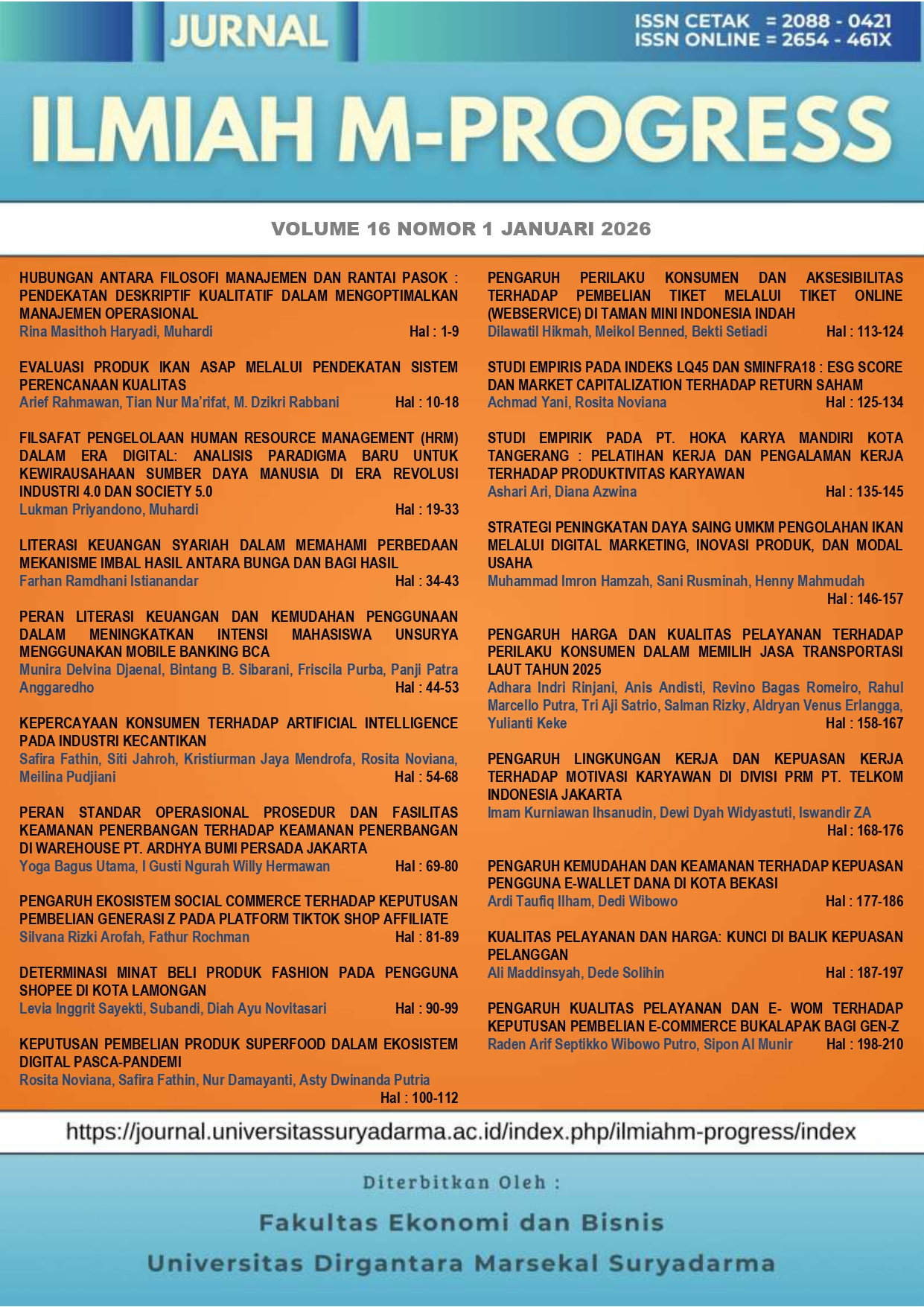
Filsafat Pengelolaan Human Resource Management (HRM) Dalam Era Digital: Analisis Paradigma Baru Untuk Kewirausahaan Sumber Daya Manusia Di Era Revolusi Industri 4.0 Dan Society 5.0
DOI:
https://doi.org/10.35968/mpu.v16i1.1829Keywords:
Digital ethics, Management philosophy, Human-centered HRM, Human resource entrepreneurship, Society 5.0Abstract
Penelitian ini bertujuan untuk menganalisis secara filosofis paradigma baru dalam pengelolaan sumber daya manusia (HRM) pada era Revolusi Industri 4.0 dan Society 5.0. Pendekatan kualitatif-deskriptif dengan analisis konseptual-filosofis digunakan untuk menelaah integrasi antara nilai kemanusiaan, etika digital, dan kewirausahaan SDM dalam membentuk model Human-Centered HRM. Data dikumpulkan melalui kajian literatur sistematis berbasis PRISMA serta wawancara semi-terstruktur dengan delapan pakar HR dan akademisi filsafat. Hasil penelitian menunjukkan bahwa HRM 5.0 menuntut keseimbangan antara kecerdasan buatan dan empati manusia melalui penguatan nilai ontologis, epistemologis, dan aksiologis dalam kebijakan organisasi. Nilai-nilai kemanusiaan, refleksi moral, dan tanggung jawab sosial menjadi landasan utama dalam menciptakan sistem pengelolaan SDM yang etis, adaptif, dan berkelanjutan. Penelitian ini menghasilkan model konseptual Human-Centered HRM Framework yang menempatkan manusia sebagai pusat inovasi dan pengambilan keputusan strategis di era digital. Model ini diharapkan dapat menjadi rujukan teoretis dan praktis dalam pengembangan manajemen SDM yang humanistik dan reflektif.References
Arini, L. O., Ardillah, D. N., & Shaddiq, S. (2025). Transformasi Manajemen Sumber Daya Manusia dalam Menghadapi Industri 5.0: Kajian Literatur Sistematis. Indonesia Economic Journal, 1(2), 1486–1491. https://doi.org/10.63822/6m5rcs70
Atay, F., Ozkeser, B., & Koseoglu, M. A. (2025). Human-centric entrepreneurship and organizational adaptation in Society 5.0. Journal of Human Resource and Sustainability Studies, 13(1), 22–34. https://doi.org/10.4236/jhrss.2025.131003
Brewster, C., Chung, C., & Sparrow, P. (2020). The future of human resource management: Managing people in changing contexts. Human Resource Management Review, 30(1), 100–110. https://doi.org/10.1016/j.hrmr.2019.100693
Creswell, J. W., & Plano Clark, V. L. (2023). Revisiting mixed methods research designs twenty years later. Handbook of Mixed Methods Research Designs, 1(1), 21–36.
Fokina-Mezentseva, E. (2024). The philosophical foundation of Industry 5.0 and the ethics of human-centered production. Philosophy and Management, 23(4), 427–441. https://doi.org/10.1007/s40926-024-00273-8
Ghobakhloo, M., Iranmanesh, M., & Maroufkhani, P. (2024). Industry 5.0: A human-centric solution to sustainability challenges. Journal of Cleaner Production, 439, 140220. https://doi.org/10.1016/j.jclepro.2024.140220
Hajar, S. (2022). Digital ethics and character education for human resource development in the era of Society 5.0. International Journal of Ethics Education, 7(2), 123–137. https://doi.org/10.1007/s40889-022-00152-5
Hammad, M. Y., Rahamaddulla, S. R., Tamyez, P. F. M., & Fauzi, M. A. (2025). From Industry 4.0 to 5.0: Leveraging AI and IoT for sustainable and human-centric operations. International Journal of Industrial Engineering and Operations Management, 17(3), 201–215. https://doi.org/10.1109/IJIEOM.2025.00421
Miles, M. B., Huberman, A. M., & Saldaña, J. (2014). Qualitative data analysis: A methods sourcebook (3rd ed.). SAGE Publications.
Moher, D., Liberati, A., Tetzlaff, J., Altman, D. G., & Group, T. P. (2009). Preferred Reporting Items for Systematic Reviews and Meta-Analyses: The PRISMA Statement. PLoS Medicine, 6(7), e1000097. https://doi.org/10.1371/journal.pmed.1000097
Pereira, A. G., & Santos, J. P. (2023). Philosophical reflections on management and the human factor in Industry 5.0. European Journal of Social Systems, 12(1), 55–69. https://doi.org/10.2478/ejss-2023-0005
Priyandono, L., Gunawan, A. W., & Muslimawati, M. (2024). Peran pemasaran konten, kualitas pelayanan, dan loyalitas pelanggan dalam meningkatkan daya saing di pasar digital. Journal of Mandalika Literature, 5(3), 584–590. https://doi.org/10.54270/jml.v5i3.584
Rahman, F., & Chandan, A. (2025). Strategic innovations in Industry 5.0: Overcoming the challenges of Industry 4.0. SCT Proceedings in Interdisciplinary Insights and Innovations, 2(1), 45–58. https://doi.org/10.1016/j.sctpro.2025.00012
Solovyova, T., & Solovova, M. (2022). Philosophical aspects of human resource management in digital transformation. Philosophy and Cosmology, 29(1), 128–138. https://doi.org/10.29202/phil-cosm/29/12
Thakur, N. (2025). The evolution of HRM 5.0: Balancing technology and human empathy in the digital workplace. Human Resource Development International, 28(3), 289–305. https://doi.org/10.1080/13678868.2025.2345129
Downloads
Published
How to Cite
Issue
Section
License
Copyright (c) 2026 JURNAL ILMIAH M-PROGRESS

This work is licensed under a Creative Commons Attribution-ShareAlike 4.0 International License.